2024-12-14
What are the components of intelligent stereoscopic warehousing?
The concept of intelligent three-dimensional warehousing is very popular. It is actually a warehousing management concept that utilizes information technology, the Internet of Things, and mechatronics integration to achieve intelligent logistics, thereby reducing warehousing costs, improving operational efficiency, and enhancing warehousing management capabilities.
In general, intelligent warehousing is a link in the logistics process. The application of intelligent warehousing ensures the speed and accuracy of data input in various aspects of warehouse management, ensuring that enterprises can timely and accurately grasp the real data of inventory, and reasonably maintain and control enterprise inventory.
RFID : The automatic identification system using the radar reflection principle of ultra-high frequency RFID system, the reader sends a microwave query signal to the electronic tag through the antenna, and the electronic tag is activated by the microwave energy of the reader. After receiving the microwave signal, it responds and sends out an echo signal with tag data information.
The basic characteristic of radio frequency identification technology is to use radio technology to identify stationary or moving objects, in order to determine the identity of the object to be identified and extract its characteristic information (or identification information).
AGV: AGV refers to a transport vehicle equipped with electromagnetic or optical automatic guidance devices, capable of traveling along a prescribed guidance path, with safety protection and various transfer functions. In industrial applications, it is a transport vehicle that does not require a driver and is powered by rechargeable batteries.
Generally, its travel route and behavior can be controlled through a computer, or an electromagnetic track can be used to set its travel route. The electromagnetic track is attached to the floor, and unmanned transport vehicles follow the information brought by the electromagnetic track to move and move.
Robot stacking: A pallet stacking robot is a robot that can neatly and automatically stack (or dismantle) packaged goods of different sizes onto pallets. To fully utilize the area of the pallet and the stability of the stacked materials, the robot has a material stacking sequence and arrangement setter.
According to different palletizing mechanisms, it can be divided into: 1. Multi joint type; 2. Cartesian coordinate type. According to the different forms of grippers, they can be divided into side clamp type, bottom drag type, and vacuum suction cup type.
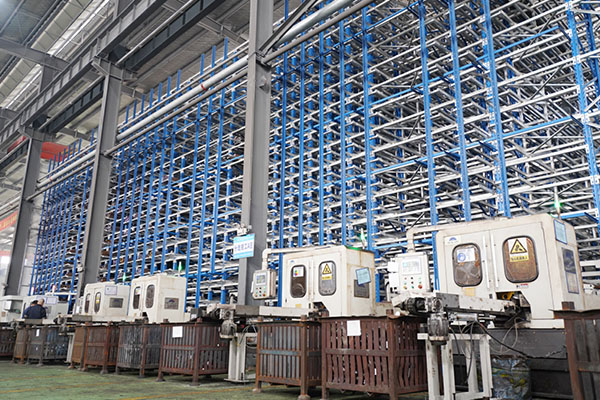
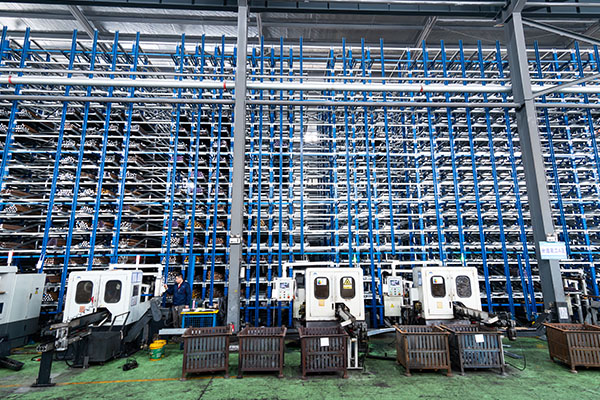
Stereoscopic warehouse: Stereoscopic warehouse, also known as high-rise shelf warehouse or Automatic Storage&Retrieval System (AS/RS). It generally uses shelves with several layers, tens or even dozens of layers, and uses automated material handling equipment for goods outbound and inbound operations in the warehouse.
A three-dimensional warehouse generally consists of high-rise shelves, material handling equipment, control and management equipment, and civil engineering public facilities.
Warehouse Management System: The Warehouse Management System (WMS) is an information management system that integrates batch management, material correspondence, inventory counting, quality inspection management, virtual warehouse management, and real-time inventory management through functions such as inbound and outbound operations, warehouse transfers, inventory transfers, and virtual warehouse management. WMS effectively controls and tracks the entire logistics and cost management process of warehouse operations, achieving comprehensive warehouse information management.
This system can independently perform logistics warehousing and inventory operations, as well as achieve intelligent integration of logistics warehousing with enterprise operations, production, procurement, and sales.
Warehouse Control System: The Warehouse Control System (WCS) is located in the middle layer between the Warehouse Management System (WMS) and logistics equipment, responsible for coordinating and scheduling various logistics equipment at the lower level, so that the lower level logistics equipment can execute the business process of the warehouse system, and this process is completely executed according to the pre-set process of the program. It is the core system that ensures the normal operation of the entire logistics and warehousing system.